Less as a Language: How Australia's Most Sophisticated Buyers Are Speaking Through Silence
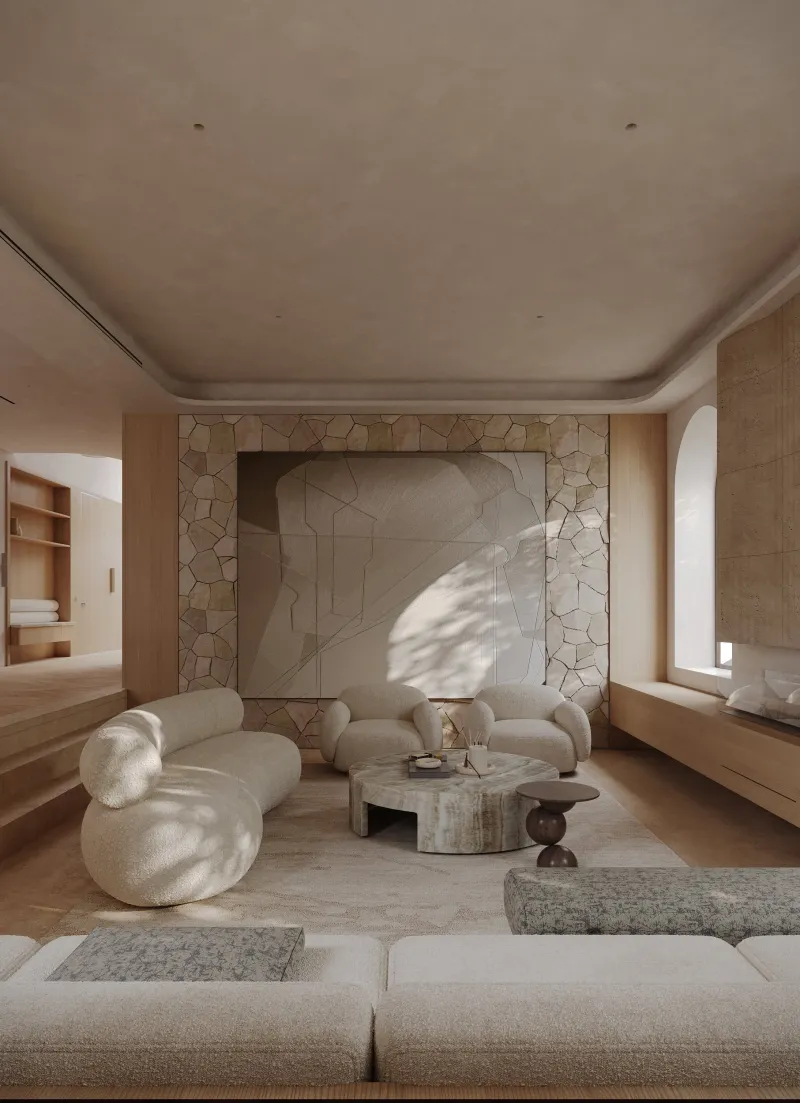
Photo: minimalist luxury Australian home interior natural light stone, via i.pinimg.com
There is a particular kind of confidence required to walk into a room and say nothing. No gilded cornices. No imported marble waterfalls. No chandelier engineered to be the first thing a visitor sees. Just proportion, light, and an almost unsettling sense of calm. Across Australia's most prestigious postcodes — from the clifftop residences of Sydney's eastern suburbs to the quiet, expansive properties lining Melbourne's Toorak Road — this studied silence is becoming the loudest signal of all.
The shift toward minimalist luxury is not simply an aesthetic preference. It is, for an increasingly influential cohort of Australian buyers, a philosophical declaration.
The End of the Obvious
For much of the past two decades, luxury real estate in Australia operated on a relatively legible grammar. Size conveyed status. Materials — rare stone, imported timber, bespoke joinery — communicated investment. Amenities multiplied: home theatres, wine cellars, car galleries, and resort-scale swimming pools became not so much personal indulgences as architectural credentials.
That grammar is being quietly retired.
What is emerging in its place is something more nuanced and, in many respects, more demanding. Buyers at the apex of the market are now asking different questions of the properties they consider. Not how much is here? but what has been removed? Not what does this say about wealth? but what does this say about values?
The homes commanding the most serious attention today are those in which every element has been interrogated. Where a lesser property might accumulate features, these residences edit them. The result is a kind of architectural precision that feels less like decoration and more like philosophy.
Sustainability as Sophistication
One of the most significant drivers of this shift is a deepening awareness of environmental responsibility among Australia's wealthiest cohort. This is not the performative sustainability of a solar panel bolted to an otherwise unreconstructed property. It is something more fundamental — a reconsideration of what a home should consume, both materially and energetically.
Minimalist design, by its nature, tends toward efficiency. Fewer surfaces require fewer materials. Cleaner lines reduce maintenance demands. Passive design principles — cross-ventilation, thermal mass, strategic orientation — become not just environmentally sound choices but aesthetic ones. In this sense, the minimalist luxury home is not sacrificing anything. It is simply aligning its values more coherently.
Across coastal properties in particular, this alignment is becoming a significant point of differentiation. A home that has been designed to work with its landscape — to capture light without overwhelming it, to frame a view rather than compete with it — communicates a kind of intelligence that no imported chandelier can replicate.
The Timelessness Premium
There is also a purely financial logic at work. The maximalist excesses of one era have a habit of becoming the renovation projects of the next. Buyers who have watched properties cycle through fashions — from the marble-and-gold interiors of the 1990s to the industrial-chic conversions of the 2000s — are increasingly drawn to design languages that resist obsolescence.
Minimalism, executed at the highest level, ages differently. Its reference points are more enduring: the proportions of classical Japanese architecture, the material honesty of Scandinavian modernism, the spatial generosity of mid-century Australian design. These influences do not date because they were never entirely of their moment to begin with.
For buyers making generational investments — properties intended to hold and appreciate across decades — this timelessness carries a very real premium. The question is no longer simply what is this worth today? but what will this mean in thirty years?
Curation as Credential
Perhaps the most telling aspect of this shift is what it demands of its practitioners. Minimalism is, counterintuitively, extraordinarily difficult to achieve well. It requires a level of discernment — in the selection of materials, in the proportioning of spaces, in the restraint exercised at every decision point — that maximalism does not. Anyone with sufficient budget can accumulate. Very few can curate.
This distinction is not lost on the buyers who are driving the trend. The homes they are drawn to are those in which the hand of a genuinely skilled architect or designer is evident not in what has been added, but in what has been resisted. A perfectly considered void. A material used once, and used definitively. A view framed so precisely that it feels like a painting hung by someone who understood exactly what they were doing.
In this context, restraint becomes its own kind of credential — one that speaks to taste, education, and a confidence that requires no external validation.
What This Means for the Australian Market
For those navigating the prestige end of the Australian property market, the implications are meaningful. Properties that have been thoughtfully edited — where interiors reflect a coherent design intelligence rather than an accumulation of expensive decisions — are attracting disproportionate interest from the most discerning buyers.
This is particularly evident in new builds and significant renovations, where buyers are increasingly willing to invest in the process of reduction: engaging architects with the brief to simplify, to strip back, to find the essential quality of a site and build only what serves it.
The market, in this sense, is beginning to reward a different kind of intelligence. Not the intelligence of acquisition, but the intelligence of knowing when to stop.
At Prestige Rockcliff, we have observed this shift with considerable interest. The properties that generate the most sustained conversation among serious buyers are rarely those with the longest list of features. They are the ones that feel, from the moment you step inside, as though nothing is missing — and nothing is surplus. That balance, achieved through discipline and vision, is increasingly where genuine prestige resides.