Fortified by Design: How Security Infrastructure Has Become the Defining Feature of Australia's Most Coveted Homes
There was a time when security in a prestige home meant little more than a deadbolt, an alarm panel tucked beside the front door, and perhaps a modest CCTV camera mounted above the garage. For Australia's wealthiest property owners, that era is firmly behind them. Today, the most sophisticated buyers entering the prestige market are approaching security not as a supplementary concern but as a primary design language — one that shapes floor plans, informs material selections, and quietly governs the spatial logic of an entire estate.
This shift has not emerged in isolation. It reflects broader changes in how high-net-worth individuals understand vulnerability, privacy, and the relationship between physical space and personal safety. As wealth becomes more visible through digital channels and public registers, the homes that shelter that wealth have had to evolve accordingly.
From Retrofit to Foundation
The most telling indicator of this transformation is timing. Historically, security consultants were engaged after an architect had completed a design — their role limited to overlaying technology onto a structure that had not been conceived with protection in mind. Today, the most reputable prestige architects in Australia are engaging security specialists during the earliest stages of a project, often before a single line is drawn.
The implications for design are considerable. Structural reinforcement, blast-resistant glazing, controlled sight lines, and the strategic positioning of entry points are now embedded into the architectural brief from the outset. The result is a home that does not merely accommodate security — it embodies it.
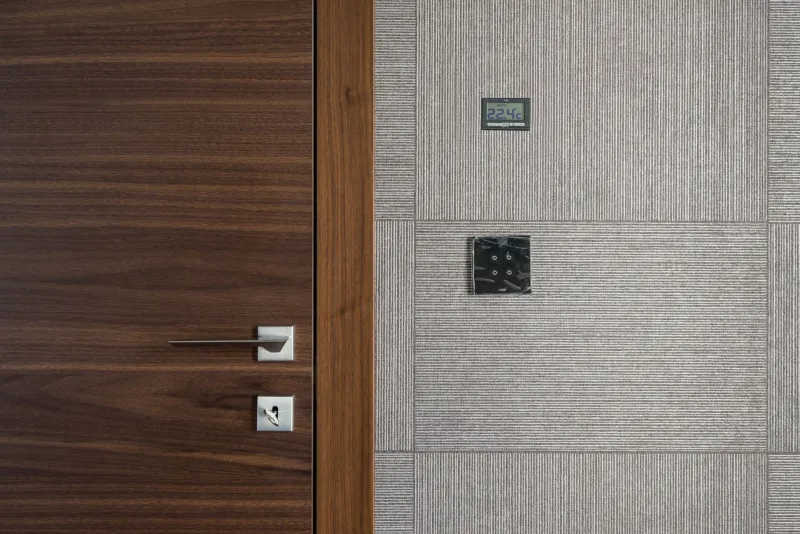
This integrated approach produces something that a retrofit never can: invisibility. When security is designed in rather than added on, it disappears into the fabric of the home. The reinforced door looks like every other door. The surveillance infrastructure is absorbed into the roofline. The safe corridor reads as a hallway. There is no visual evidence of anxiety — only the quiet confidence of a structure that has been conceived with total intentionality.
The Anatomy of a Secured Estate
For buyers at the apex of Australia's prestige market — those acquiring properties in the $15 million to $50 million range across locations such as Point Piper, Toorak, Mosman, and Dalkeith — the security specification has become as detailed and considered as the kitchen fitout or the landscape design.
Perimeter intelligence forms the first layer. Sophisticated sensor networks, often combining thermal imaging, ground-based motion detection, and AI-assisted camera systems, establish a monitored boundary well before any visitor reaches the residence itself. These systems are designed to identify and log anomalies without triggering the kind of visible security theatre that undermines the aesthetic of a finely considered property.
Access architecture represents the second layer. Biometric authentication — fingerprint, retinal, or facial recognition — has largely replaced keypad entry systems in the highest-tier properties. Vehicular access is managed through hydraulic bollards or automated gate systems capable of withstanding significant force, often specified to standards aligned with commercial security protocols. Visitor management systems allow residents to pre-authorise guests, monitor arrivals remotely, and revoke access in real time.
Interior safe rooms — referred to in the industry as secure refuges — have evolved dramatically from the reinforced bunkers of earlier decades. Contemporary iterations are designed and furnished as liveable spaces: climate-controlled, acoustically treated, equipped with independent communications infrastructure, and finished to the same standard as the primary living areas. A well-executed secure refuge is indistinguishable from a private study or media room until the moment it is required to perform.
Aesthetics and Armour
The central challenge for designers working within this brief is reconciling the demands of protection with the expectations of beauty. A prestige home must still feel like a home — warm, considered, and free of institutional undertones. Security infrastructure, if handled poorly, can introduce a clinical quality that works against everything a luxury property is designed to evoke.
The most accomplished practitioners resolve this tension through material intelligence. Ballistic-rated glazing is now manufactured to optical standards indistinguishable from standard high-performance glass. Reinforced door cores are concealed within custom-crafted timber or stone facades. Cable management for surveillance systems is routed through purpose-built cavities during construction, eliminating surface conduit entirely. The technology serves the architecture rather than competing with it.
Lighting design has also emerged as a subtle but effective security tool. Carefully layered exterior illumination can eliminate shadow zones that might otherwise provide concealment, while simultaneously enhancing the visual drama of a property at night. Security and beauty, in this context, are not in opposition — they are aligned.
The Discretion Premium
Among Australia's most experienced prestige agents, there is growing recognition that robust security infrastructure adds measurable value to a property — not simply because it reduces risk, but because it signals a level of consideration and completeness that discerning buyers respond to instinctively.
A home that has been secured thoughtfully communicates something about the calibre of its conception. It suggests that every system, every material, and every spatial decision has been interrogated with the same rigour. For buyers who have spent careers making high-stakes judgements, that signal carries genuine weight.
There is also a practical dimension that is difficult to quantify but impossible to ignore. For high-profile individuals — executives, public figures, prominent families — the ability to move through their own home with genuine ease, unencumbered by the low-level vigilance that insecurity demands, represents a quality of life benefit that transcends any line item on a property specification sheet.
A New Standard of Completeness
The prestige property market has always been defined by the relentless refinement of what completeness means. A generation ago, completion meant the finest finishes and the most desirable address. More recently, it has come to include wellness infrastructure, environmental performance, and technological integration. Security, long treated as a category apart, has now joined that constellation of essentials.
For Australia's most discerning buyers, a property that has not been conceived with security at its core is, by definition, an incomplete one. The vault effect — that quality of impenetrable calm that the finest secured estates project — is no longer a luxury within the luxury market. It is the standard against which everything else is measured.