The Distance Dividend: Why Australia's Wealthiest Buyers Are Paying a Premium to Be Unreachable
For decades, proximity was the grammar of prestige. A harbourside address in Sydney, a South Yarra terrace within walking distance of the finest restaurants, a Toorak estate timed to the school bell — location, in its most conventional sense, was the shorthand for status. But something has shifted, quietly and decisively, among Australia's most sophisticated property buyers. The coordinates of aspiration are moving outward, and the further the address, it seems, the greater the allure.
The question worth asking is not merely where these buyers are going. It is why distance itself has become the most desirable amenity on the market.
Redefining the Premium Address
The logic of urban proximity was never purely about convenience. It was about access — to culture, to commerce, to the social infrastructure that wealth historically required. That infrastructure has not disappeared, but it has, for a particular class of buyer, become optional. Private aviation, satellite connectivity, and the quiet normalisation of remote working among executives and entrepreneurs have untethered high-net-worth individuals from the postcode calculus that once governed their decisions.
What remains, once convenience is removed from the equation, is something more elemental: the question of what a property can provide on its own terms. And increasingly, the answer that commands the highest premiums is everything.
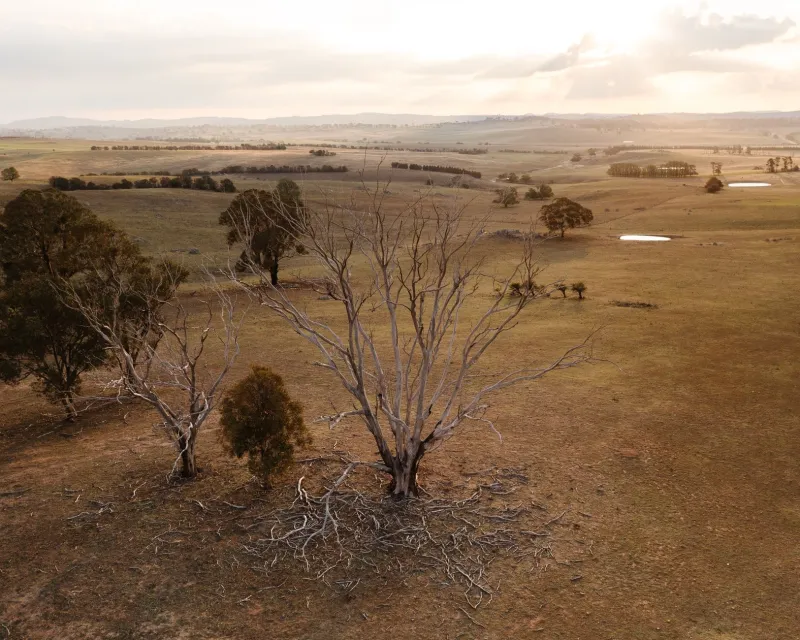
Across the Monaro tablelands of New South Wales, the red-soil pastoral country of South Australia's mid-north, and the dramatic hinterland ridgelines above Queensland's Sunshine Coast, a new generation of prestige estates is being built — or painstakingly acquired — around the principle of complete self-sufficiency. These are not hobby farms or weekend retreats. They are sovereign environments: properties that generate their own power, harvest and treat their own water, manage their own land, and function indefinitely without reference to any public utility or external service.
The Infrastructure of Independence
To understand why this matters to buyers at the apex of the Australian market, it is worth examining what self-sufficiency actually requires at this level. The estates commanding the most serious attention are not those that have merely installed a solar array and a rainwater tank. They are properties where the engineering of independence has been treated with the same rigour as the architecture of the dwelling itself.
Large-scale photovoltaic systems paired with commercial-grade battery storage. Bore water infrastructure fed through multi-stage filtration. Greywater recycling systems integrated into irrigated kitchen gardens and orchards. On-site fuel reserves. Private helipads with instrument-rated lighting. Satellite uplinks providing redundant internet connectivity. In some instances, private airstrips.
The capital required to assemble this infrastructure is substantial — in some cases rivalling or exceeding the value of the principal residence. Yet buyers are not merely tolerating this cost. They are actively seeking it out, because what the infrastructure represents transcends utility. It represents invulnerability.
In an era of increasing anxiety about grid reliability, water security, and the fragility of supply chains — anxieties that have been sharpened by successive natural disasters, pandemic-era disruptions, and an increasingly volatile climate — the ability to operate entirely outside public systems is not an eccentricity. It is a form of insurance that no financial product can replicate.
Distance as a Design Philosophy
There is, of course, a psychological dimension to this movement that cannot be reduced to risk mitigation. The buyers drawn to these properties are not, by and large, survivalists. They are individuals of considerable cultural refinement who have simply concluded that the deepest expression of luxury is not accumulation but autonomy.
In conversation with principals across some of Australia's most discreet prestige transactions, a recurring phrase emerges: the idea of the estate as a complete world. Not a retreat from life, but a distillation of it — a property so thoughtfully conceived that it contains, within its boundaries, everything its owner values. A working vineyard. A private beach or river frontage accessible only by the estate's own track. A stable of horses managed by on-site staff. A chef's garden that supplies the main kitchen. A library, a cellar, a workshop.
The aspiration, at its most refined, is not to escape the world but to render it irrelevant.
This philosophy has profound implications for how these properties are presented and perceived. The traditional real estate metrics — land size, bedroom count, proximity to amenities — become almost secondary. What matters, and what the most discerning buyers are interrogating in extraordinary detail, is the coherence and completeness of the property as an independent system. Does the water supply hold through a drought year? What is the realistic generation capacity of the energy system in winter? How many staff does the estate require to function, and is that accommodation appropriate?
The Coastal Corollary
It would be a mistake to assume that this appetite for isolation is confined to Australia's inland pastoral properties. Along the continent's more remote coastlines — the rugged headlands of the Eyre Peninsula, the wild southern shores of Tasmania, the dramatically isolated capes of Western Australia's south-west — a parallel market has emerged for coastal estates that combine the visual theatre of the ocean with the same principle of sovereign remove.
These properties present a different set of engineering challenges. Marine environments demand particular attention to the durability and maintenance of infrastructure. Water catchment must account for salt-laden air. Energy systems must be rated for coastal conditions. But the reward for solving these problems is a category of property that is, in practical terms, irreplaceable: a clifftop or bay-frontage estate that sits entirely beyond the reach of neighbours, roads, and services, yet functions with the quiet efficiency of a well-run private hotel.
For buyers who have spent decades in proximity to others — in city apartments, in gated suburban estates, in resort-style coastal developments — the experience of genuine solitude, underpinned by genuine self-sufficiency, is not merely pleasant. It is transformative.
The Market Signal
For those observing the prestige property market with a long view, the rise of the self-sufficient estate represents something more than a lifestyle trend. It is a reallocation of value — a signal that the market's most sophisticated participants are pricing a new set of attributes into their decisions.
Properties that would once have been assessed primarily on their pastoral productivity or their scenic merit are now being evaluated as complete systems, and the premium attached to robust, well-documented self-sufficiency infrastructure is growing measurably. In some instances, the presence of a fully integrated off-grid energy and water system has proven decisive in negotiations where comparable properties — more conventionally appointed, but grid-dependent — have sat unsold.
The implication for vendors is clear. The buyers who are driving price discovery at the upper end of this market are not looking for a property to connect to the world. They are looking for a property that makes the world's connection unnecessary.
In that context, distance is not a compromise. It is the point.