Nothing to Prove: How Deliberate Emptiness Became the Ultimate Status Symbol in Australia's Finest Homes
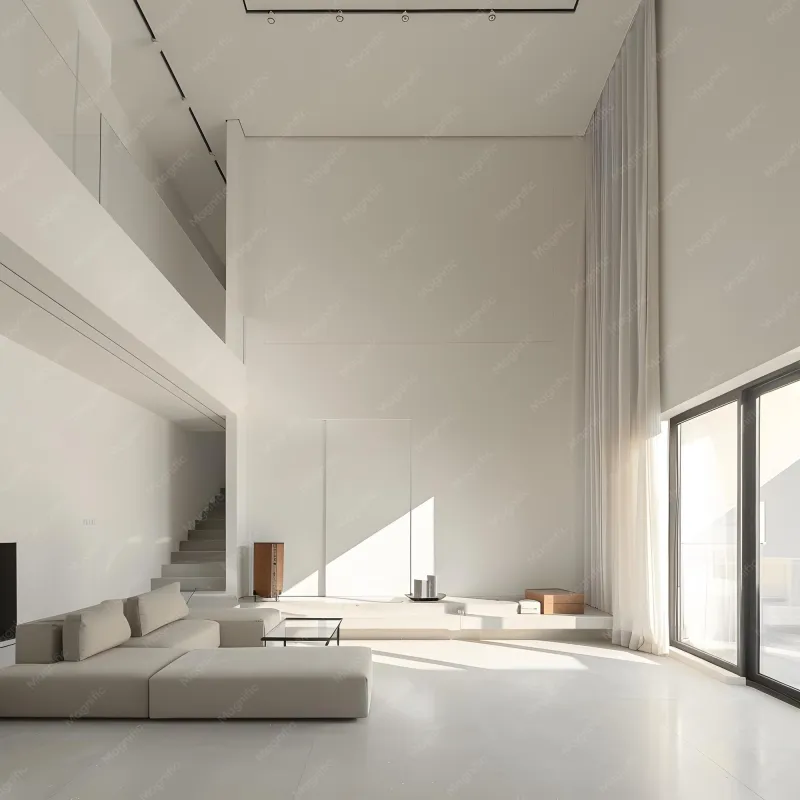
Photo: minimalist luxury interior empty white wall natural light Australian home, via img.freepik.com
There is a particular kind of confidence required to leave a wall empty. Not the blankness of a home yet to be furnished, nor the oversight of an owner who simply hasn't gotten around to hanging anything — but a considered, almost philosophical decision to let space speak where objects cannot. In Australia's most distinguished residences, from the clifftop retreats of Sydney's Northern Beaches to the grand terraces of Melbourne's Toorak, this kind of deliberate restraint is quietly redefining what it means to live well.
For decades, the signifiers of luxury in Australian property were largely additive: more art, more marble, more statement furniture. The trophy home announced itself through accumulation. Today, the most sophisticated buyers are inverting that logic entirely.
The Philosophy of the Unoccupied Wall
At its core, the turn toward minimalism in prestige interiors is not merely aesthetic — it is philosophical. The empty wall is not a void. It is, for those who understand it, a declaration: that the owner has nothing left to prove.
This sensibility has deep roots in Japanese design philosophy, particularly the concept of ma — the meaningful pause, the purposeful interval. But it has found a distinctly Australian expression, shaped by the country's relationship with light, landscape, and a cultural suspicion of ostentation that has long sat beneath the surface of its wealthiest circles.
Designers working across Sydney, Melbourne, and the Gold Coast's prestige corridors speak of clients who arrive at consultations having already decided what they will not include. The brief is not "fill this space" but rather "protect this space." The conversation begins not with selection but with subtraction.
"The clients who truly understand restraint are not interested in impressing visitors," notes one prominent Sydney-based interior designer who works exclusively in the prestige residential sector. "They are interested in how the space makes them feel when no one else is present. That is a fundamentally different ambition, and it produces fundamentally different homes."
Curation as Confidence
To understand why emptiness has become a luxury commodity, it helps to consider what filling a space actually costs — not financially, but intellectually and emotionally. The maximalist interior demands constant justification. Every object competes for attention. Every wall asserts a claim.
The curated minimal interior, by contrast, demands a different kind of discipline: the willingness to acquire something extraordinary and then resist the urge to surround it with lesser things. Australia's most serious private collectors — those whose holdings span Streeton, Nolan, and contemporary works by artists such as Patricia Piccinini or Ben Quilty — increasingly speak of their finest pieces as requiring what one collector described as "breathing room."
When a single significant canvas occupies an entire wall — or when one sculptural work anchors an otherwise unadorned room — the hierarchy is unambiguous. There is no visual competition, no dilution of impact. The work is elevated precisely because everything around it has been removed.
This approach also reflects a more considered relationship with acquisition itself. Where a previous generation of wealthy Australians may have collected broadly and displayed comprehensively, today's ultra-high-net-worth buyers tend to collect slowly, selectively, and with a long horizon. The empty wall is not waiting to be filled. In many cases, it is finished.
Negative Space as Investment Logic
There is also a compelling investment dimension to this shift — one that aligns naturally with the editorial perspective of those who view prestige property as a long-term store of value.
Interiors that are stripped of trend-dependent furnishings and decoration age with extraordinary grace. The architectural bones of a well-designed prestige home — its proportions, its materials, its relationship to light and view — are revealed rather than obscured when the interior is allowed to breathe. Buyers who eventually come to purchase such a property are not inheriting someone else's taste. They are receiving a canvas.
This distinction carries measurable weight in the prestige market. Properties presented with deliberate restraint consistently attract buyers who are themselves discerning — and who recognise the absence of clutter as evidence of underlying quality rather than absence of effort. The result, experienced agents note, is that minimal interiors often generate stronger competition among a more selective pool of buyers.
The Architecture of Stillness
Perhaps the most telling measure of this movement is the way it has begun to influence architectural briefs themselves. Prestige residential architects across Australia's major markets report that clients are now requesting homes designed specifically around the experience of emptiness — rooms with proportions generous enough to feel complete without furniture, corridors whose length is appreciated rather than merely traversed, and views that serve as the primary artwork in every principal room.
In coastal properties particularly, the logic is self-evident. When a home commands an unobstructed view of the Tasman Sea, or looks out across Sydney Harbour, or frames the Mornington Peninsula's rolling hills, the interior's role is fundamentally supportive. It must not compete. The most sophisticated architectural response to such a setting is to make the interior as quiet as possible — so that the exterior can do what it does best.
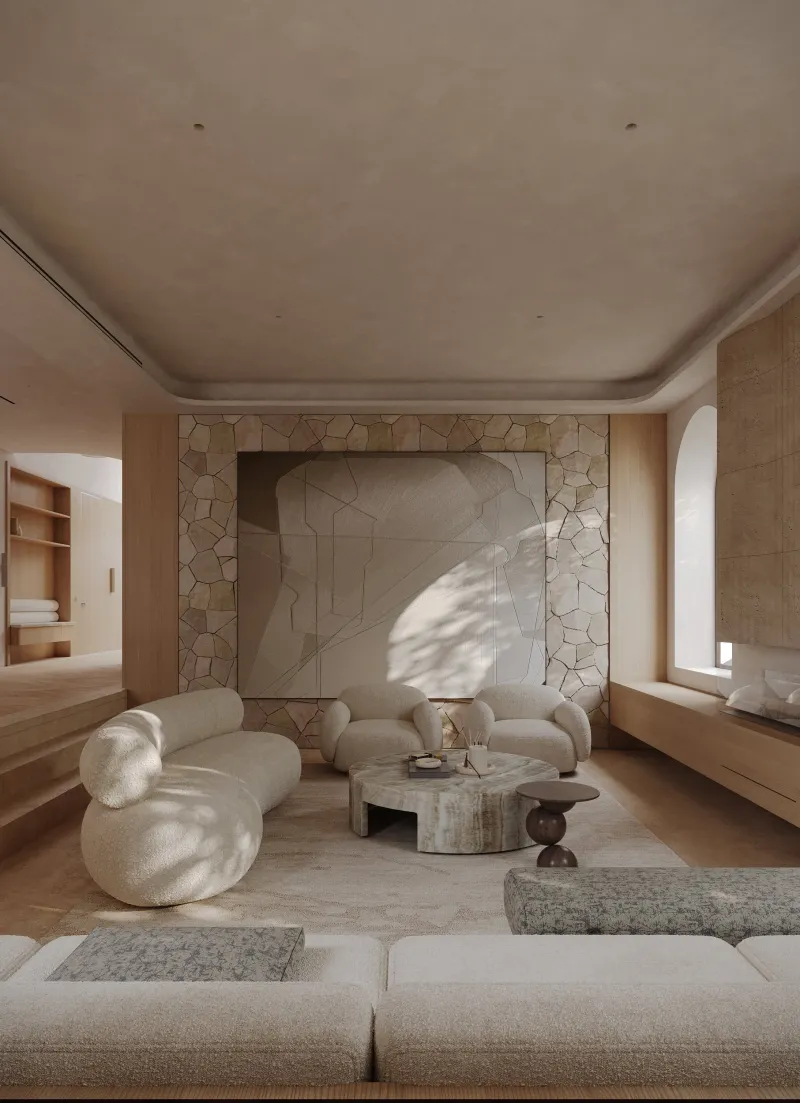
This principle extends to material selection. Pale stone, raw timber, and textured plaster surfaces that absorb and diffuse light without demanding attention have become the hallmarks of prestige interiors that understand their own purpose. They are backgrounds that know they are backgrounds — and are all the more beautiful for it.
What Silence Signals
In the end, the deliberate emptiness of Australia's most admired interiors communicates something that no amount of acquisition can replicate: certainty. The owner who leaves a wall bare has made a decision that cannot be undone by fashion, by the arrival of a new collection, or by the opinions of others. They have committed to a vision of how space should feel, and they have had the discipline to hold to it.
In a market where prestige properties are increasingly evaluated not only on their physical attributes but on the quality of life they promise, that kind of clarity carries its own premium. The most sophisticated buyers recognise it immediately — not because it is obvious, but because it speaks a language they already understand.
The empty wall, it turns out, says everything.