Tides of Consequence: How Climate Intelligence Is Reshaping Australia's Coastal Prestige Market
For as long as Australia has had a prestige property market, the coast has been its spiritual centre. The combination of maritime light, salt-edged air, and the particular social gravity of a well-positioned waterfront address has made coastal real estate the aspirational benchmark against which all other property is measured.
That fundamental appeal has not diminished. What has changed, with quiet but unmistakable force, is the sophistication with which Australia's most informed buyers are evaluating what a coastal address actually means — not today, but across the decades and generations for which prestige property is typically held.
A New Layer of Due Diligence
The standard suite of pre-purchase investigations — building and pest inspections, title searches, council planning overlays — has long been considered the baseline of responsible acquisition. For properties in the lower and middle segments of the market, this remains largely adequate. But among buyers operating at the upper end of Australia's coastal markets, from the Mornington Peninsula to the Northern Beaches of Sydney, from the Whitsundays to the limestone cliffs of Margaret River, a substantially more rigorous framework has begun to take hold.
Environmental consultants, once engaged primarily for rural or commercial transactions, are increasingly being retained for residential prestige purchases. Their briefs are expansive: coastal erosion modelling, sea-level projection analysis, stormwater and drainage vulnerability assessments, and detailed evaluations of how a given property's immediate geography is likely to respond to intensified weather events over a twenty, thirty, or fifty-year horizon.
This is not, it should be emphasised, a counsel of pessimism. The buyers commissioning these studies are not retreating from the coast. They are simply insisting on understanding it with a depth of precision that matches the significance of the investment.
The Role of Geological Forecasting
Beneath the aesthetics of any coastal property lies a geological reality that marketing materials rarely address. The stability of clifftop positions, the behaviour of sandy substrates under prolonged inundation, the drainage characteristics of estuarine land — these are not abstract concerns. They are material factors that directly influence the long-term structural integrity, insurability, and ultimately the value of a prestige coastal holding.
Geotechnical engineers are now a familiar presence in the acquisition process for significant coastal properties. Their assessments go beyond the immediate site to consider the broader landform: how the surrounding topography channels water, where erosion fronts are advancing, and whether the protections that currently exist — natural or engineered — are likely to remain effective under projected climate scenarios.
Some of the findings from this work are reassuring. Certain coastal geologies, particularly those characterised by hard rock formations, demonstrate a resilience to climatic stress that less scrutinised sites cannot offer. Others reveal vulnerabilities that, while not immediately apparent, represent genuine long-term risks to capital preservation.
For buyers whose investment horizon extends to the next generation, this information is not optional. It is foundational.
Water Security Beyond the Shore
The conversation around coastal climate risk has also expanded to encompass fresh water — specifically, the reliability and quality of water supply in the context of extended drought cycles, aquifer depletion, and the increasing pressure on municipal infrastructure in high-demand coastal areas.
Properties with independent water sources — bore water, rainwater harvesting systems, or access to reliable surface catchments — are attracting measurable premiums among buyers who understand that water security is not simply a rural concern. In a country with Australia's climatic variability, a prestige coastal property that is genuinely self-sufficient in water represents a form of resilience that extends well beyond comfort.
This consideration is particularly pronounced in coastal regions of Western Australia and Queensland, where extended dry periods and the limitations of reticulated supply have already concentrated minds. But it is increasingly relevant across the full spectrum of Australia's coastal prestige markets.
Insurance, Liability, and the Quiet Repricing of Risk
The insurance industry has, in many respects, already begun the repricing of coastal climate risk — quietly, systematically, and with implications that are only beginning to be fully understood by the property market. Premiums for properties in identified high-risk coastal zones have risen substantially in recent years, and in some cases, coverage has become difficult to obtain on commercially viable terms.
For buyers at the prestige end of the market, this is not merely a financial inconvenience. It is a signal. The same actuarial intelligence that drives insurance pricing is, in aggregate, a sophisticated assessment of long-term climate risk — one that buyers would be well-served to understand before committing to a significant coastal acquisition.
Properties that demonstrate genuine climate resilience — through their geology, their elevation, their engineering, or their environmental buffers — are increasingly able to differentiate themselves not only on lifestyle grounds but on the harder metric of long-term financial security.
The Enduring Appeal, Recalibrated
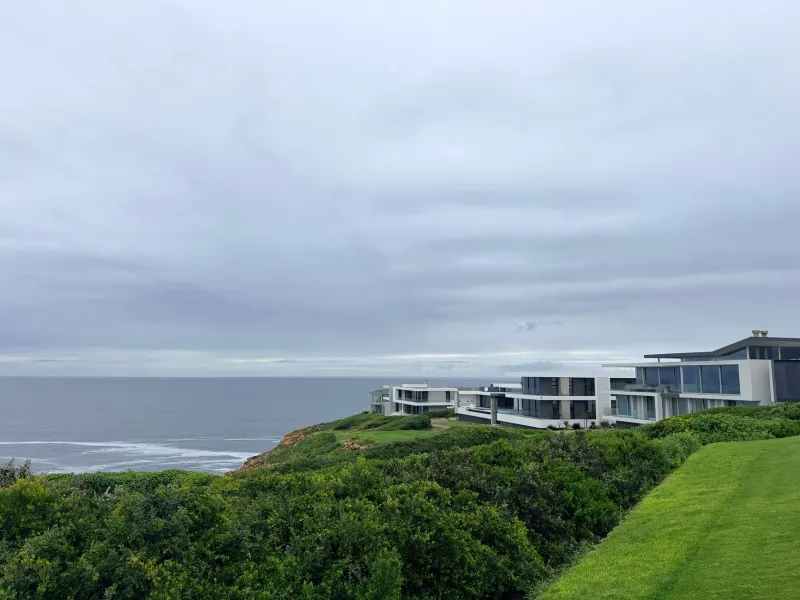
None of this analysis should be mistaken for a diminishment of the coast's enduring allure. The finest coastal properties in Australia remain among the most compelling assets available anywhere in the world. The Pacific light that falls across a clifftop terrace in the late afternoon, the particular silence of a sheltered bay at dawn — these are not things that environmental modelling can quantify or diminish.
What the new rigour of climate-informed due diligence does, rather, is separate the genuinely exceptional from the merely scenic. It rewards the buyers who look beneath the surface — literally and figuratively — and identifies the properties that will endure not just through a market cycle, but through the longer, less predictable cycles that the Australian coast has always been subject to.
In this sense, climate intelligence has not complicated the prestige coastal market. It has clarified it. And for those with the patience and the expertise to undertake this level of inquiry, the clarity it provides is itself a form of competitive advantage.