What Lies Beneath: How Geological Integrity Has Become Australia's Most Undervalued Prestige Property Asset
There is a particular kind of confidence that comes from standing on something immovable. In Australia's prestige property market — where buyers routinely commit eight and nine-figure sums to homes perched above Pacific headlands or nestled into sandstone ridgelines — that confidence is increasingly being sought not from the architect's portfolio or the interior designer's credentials, but from the geological record itself.
A quiet shift is underway. Among the nation's most discerning buyers, geological stability has graduated from a technical footnote to a genuine acquisition criterion. The ground beneath a property, once considered the exclusive concern of engineers and insurers, is now entering the lexicon of luxury real estate with a persuasiveness that few anticipated.
The Foundation Beneath the Façade
Australia sits atop one of the world's most ancient and geologically stable continental plates. This antiquity, however, does not distribute its benefits evenly. Beneath the country's most sought-after coastal suburbs and harbourside enclaves, the subsurface geology varies enormously — from the durable Hawkesbury sandstone formations that underpin much of Sydney's northern and eastern cliff faces, to the basaltic rock shelves that anchor elevated properties along Queensland's Sunshine Coast hinterland, to the granite outcrops that define premium parcels in parts of South Australia's Fleurieu Peninsula.
In contrast, many equally prestigious-looking addresses sit atop compacted fill, clay-heavy soils, or reclaimed coastal land — substrates that perform adequately under ordinary conditions but reveal their limitations when subjected to prolonged drought, heavy rainfall events, or the slow creep of coastal erosion. The consequences range from the inconvenient to the catastrophic: foundation movement, drainage failure, retaining wall collapse, and in extreme cases, the kind of structural compromise that no renovation budget can fully address.
For buyers operating at the upper end of the market, these are not abstract risks. They are balance sheet considerations.
Why Sophisticated Buyers Are Commissioning Geological Surveys
The standard building and pest inspection, long the cornerstone of Australian property due diligence, examines what has already been built. It cannot tell a buyer what the land itself is likely to do over the next fifty years under changing climatic conditions. A geological survey — or more precisely, a geotechnical assessment — fills that gap with a rigour that is difficult to replicate through any other means.
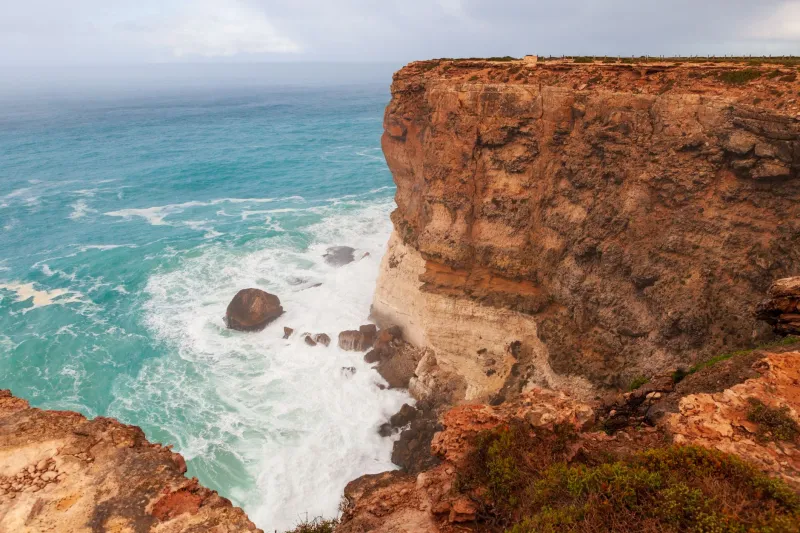
Engineers engaged at this level examine soil classification, rock depth, groundwater behaviour, slope stability, and the land's historical response to seismic activity and erosion. For coastal properties specifically, they also assess the rate and pattern of cliff recession, the integrity of the interface between built structures and natural rock, and the long-term viability of the site given projected sea level modelling.
The buyers commissioning these assessments are not doing so out of anxiety. They are doing so out of precision. In a market where the difference between two comparable properties can hinge on a single geological variable, having that data is a competitive advantage — both at the point of acquisition and, critically, at the point of eventual resale.
The Premium of Permanence
Properties anchored to solid bedrock carry a structural argument that no amount of architectural embellishment can manufacture. When a clifftop residence in Sydney's northern beaches or a headland estate along Victoria's Mornington Peninsula is demonstrably founded on ancient rock rather than unconsolidated sediment, that fact speaks directly to longevity — and longevity, in the prestige market, commands a premium.
This premium is not always itemised on a contract of sale, but it is increasingly reflected in the comparative analysis that informs high-end valuations. Properties with documented geotechnical assessments and confirmed bedrock foundations are beginning to attract a category of buyer who views that documentation as a form of provenance — as meaningful, in its own way, as a certificate of architectural heritage or a record of original craftsmanship.
The analogy to fine art or collectibles is not incidental. Just as a discerning collector will not acquire a significant work without exhaustive provenance research, a discerning property buyer is learning to demand an equivalent standard of foundational due diligence.
Climate Variability as a Catalyst
The intensification of Australia's climate variability has accelerated this shift in buyer behaviour in ways that are both practical and psychological. The east coast flooding events of recent years, the erosion episodes that have reshaped sections of Queensland's Gold Coast, and the increasing frequency of landslip incidents in elevated residential areas have collectively focused attention on land stability in a manner that decades of engineering advice alone could not achieve.
Insurance markets have responded accordingly. In certain postcodes, the cost and availability of comprehensive building coverage is now directly influenced by subsurface conditions — a development that has introduced a financial dimension to geological risk that was previously more theoretical than tangible. For buyers acquiring prestige properties as long-term holdings or generational assets, the insurance trajectory of a site is no longer peripheral information. It is central to the investment thesis.
Bedrock-anchored properties in this context offer something beyond structural reassurance. They offer a degree of insulation from the escalating costs and coverage limitations that are beginning to affect more geologically vulnerable addresses — a form of quiet, enduring advantage that compounds in value as climate variability becomes more pronounced.
The Language of Long-Term Thinking
What distinguishes the buyers now prioritising geological integrity is not merely their wealth but their temporal orientation. These are individuals and families thinking in decades, not market cycles. They are acquiring properties not simply to occupy or to leverage, but to hold — to pass forward through generations with their value and their structural integrity intact.
For that cohort, the question of what a property is built on is inseparable from the question of what it will become. A home founded on ancient rock carries with it a kind of geological warranty that no builder's guarantee can replicate — a silent testament to the permanence of the site itself, independent of whatever has been constructed upon it.
At Prestige Rockcliff, we have observed this orientation emerging with increasing clarity among the buyers who approach the market with the greatest sophistication. The enquiries have shifted. The questions have deepened. And the due diligence — geological surveys included — has become a mark of the serious buyer rather than the cautious one.
A New Benchmark in Due Diligence
The integration of geotechnical assessment into prestige property acquisition represents a maturation of the Australian luxury market — a recognition that excellence in a home extends all the way down to the stratum on which it stands. As climate pressures intensify, as insurance markets recalibrate, and as generational buyers demand greater certainty from their most significant holdings, the geological credentials of a property will become an increasingly audible part of the conversation.
The most exceptional properties have always commanded exceptional scrutiny. What is changing is the depth to which that scrutiny now reaches.