Exposed by Excellence: How Australia's Elite Property Owners Are Reclaiming Control in the Age of Digital Scrutiny
There is an inherent contradiction at the heart of selling an extraordinary home. The very qualities that make a property worth tens of millions of dollars — the architectural provenance, the irreplaceable location, the curated interiors — are precisely the qualities that attract unwanted attention the moment they are placed before the public. For Australia's ultra-high-net-worth vendors, the act of selling has become an exercise not merely in property marketing, but in information governance.
The digital age has fundamentally altered the calculus of prestige real estate. Where once a discreet advertisement in a broadsheet weekend supplement and a handful of telephone calls to known buyers constituted an adequate campaign, today's market demands a presence across platforms that were, until recently, the exclusive province of lifestyle influencers and consumer brands. The result is a tension that no amount of professional polish entirely resolves: visibility and vulnerability now arrive as a matched pair.
The Anatomy of Unwanted Attention
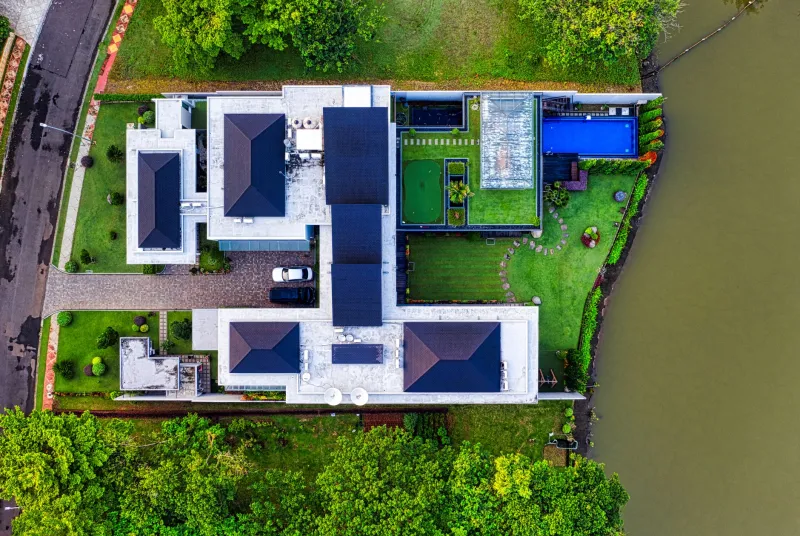
When a significant property enters the market in Sydney's lower North Shore, Melbourne's inner east, or along Queensland's Whitsunday coastline, the consequences extend well beyond the transaction itself. Aerial photography published on listing portals reveals security perimeters. Interior imagery discloses personal collections, bespoke fittings, and the spatial logic of how a family actually lives. Social media aggregators — accounts devoted to cataloguing high-value real estate — can redistribute that imagery to audiences of hundreds of thousands within hours of a listing going live.
For vendors who have spent considerable resources constructing a life of considered privacy, this exposure carries costs that no sale price can fully offset. Security consultants note that published floor plans and high-resolution photography effectively serve as reconnaissance for those with less legitimate interests. The concern is not hypothetical. Several prominent Australian families have quietly withdrawn properties from public platforms mid-campaign, absorbing the commercial cost of reduced competition rather than tolerating the ongoing exposure.
The prestige agent, caught between the vendor's requirement for confidentiality and the buyer's expectation of comprehensive information, must navigate this dilemma with considerable skill.
The Emergence of the Controlled Reveal
Leading agencies across Australia have responded by developing what might be described as a tiered disclosure architecture — a structured approach to releasing property information that calibrates exposure to the verified seriousness of each prospective buyer.
At the outermost layer, a property may be represented by nothing more than a geographic descriptor and a price range, circulated exclusively within a principal's established network. No address. No imagery. Merely an indication that something of consequence has become available in a particular precinct. This approach, sometimes called a silent listing or off-market placement, has grown substantially in popularity among vendors for whom the transaction itself is secondary to the manner in which it is conducted.
For those who require broader reach, a second tier involves selective engagement with verified high-net-worth individuals through encrypted communication channels and invitation-only digital platforms. These environments — several of which have emerged specifically to serve the Australian prestige market — require prospective buyers to submit identity verification and financial qualification documentation before any property details are disclosed. The barrier to entry is, by design, prohibitive to the casually curious.
Only at the third and most public tier does a property enter the conventional listing ecosystem — and even then, leading agents exercise considerable editorial control over the imagery and copy deployed. Wide-angle photography that contextualises security infrastructure is withheld. Rooms that would reveal too much about a vendor's personal life are excluded from the visual narrative. Addresses are occasionally withheld until a signed confidentiality agreement has been executed.
Narrative as a Protective Instrument
Beyond the mechanics of information control, sophisticated agents have come to understand that the story told about a property is itself a form of protection. A carefully constructed media narrative — released through trusted editorial partners rather than open social platforms — can generate the awareness required to attract qualified buyers while simultaneously signalling that this is not a property for the merely wealthy.
The language employed in prestige marketing serves a gatekeeping function that is rarely acknowledged explicitly. Descriptions that emphasise rarity, restraint, and the requirement for a particular kind of buyer communicate, to those who understand the register, that casual enquiry is neither expected nor welcome. This is not elitism for its own sake; it is a practical mechanism for ensuring that the vendor's time, and their privacy, is not squandered on parties who lack both the means and the intent to transact.
Some of Australia's most respected prestige agents have gone further, cultivating relationships with architectural and lifestyle publications whose readership skews precisely toward the buyer profile their clients require. A considered editorial feature — one that celebrates a property's design heritage without disclosing its precise location or internal security arrangements — can reach the right audience while presenting a version of the property that the vendor has explicitly sanctioned.
The Buyer's Expectation of Reciprocal Discretion
It is worth noting that the discretion demanded by vendors is, in most cases, equally valued by the buyers they are seeking to attract. Australia's most active prestige buyers — a cohort that includes established dynastic families, senior corporate figures, and internationally mobile high-net-worth individuals — have their own reasons for preferring transactions that leave no public record.
For these buyers, the knowledge that a vendor has taken extraordinary measures to protect the integrity of a sale is itself a form of quality signal. It suggests that the property, and the relationship being entered into, is of a calibre that warrants careful handling. Agents who can demonstrate a credible history of managing sensitive transactions — who can point to completed sales that generated no public commentary whatsoever — command a premium in this market that has nothing to do with their marketing budgets.
Discretion as a Competitive Differentiator
The agencies best positioned to serve this market are those that have invested not merely in the technological infrastructure of controlled disclosure, but in the human relationships that underpin it. A database of verified ultra-high-net-worth buyers, cultivated over years and maintained with genuine care, is a more valuable asset than any advertising platform. The telephone call from a trusted agent, made to a buyer who has previously expressed interest in a particular type of property, remains the most efficient transaction mechanism in prestige real estate — and the most private.
What has changed is that the agents who make those calls must now also manage a broader digital environment that did not exist a decade ago. The skill lies in using that environment strategically: allowing enough visibility to attract competition and validate price, while retaining sufficient control to protect the vendor's most fundamental requirement.
In a market defined by the exceptional, the ability to sell without being seen has become one of the rarest capabilities of all.